
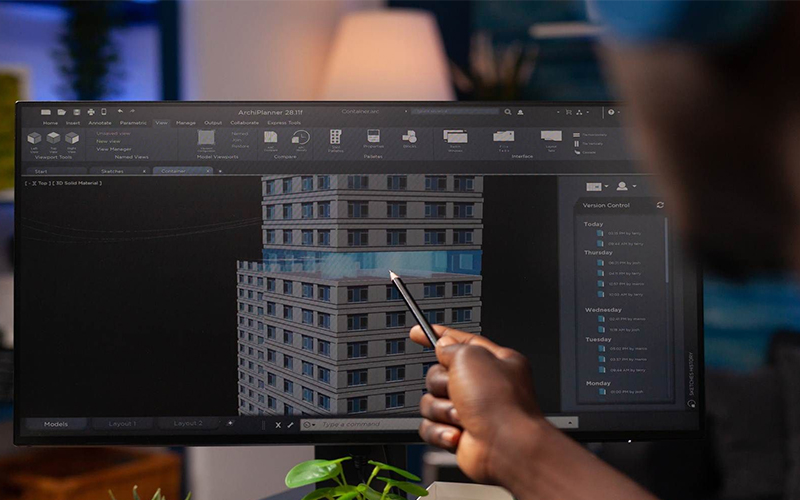
With the construction industry constantly changing, BIM Services have revolutionized how projects get planned, designed, and delivered. As a cutting-edge company, Genesis Infoserve is convinced that the integration of Building Information Modeling (BIM) in construction processes is no longer an optional extravagance, and it’s imperative. The capacity to unite architects, engineers, contractors, and stakeholders on a common digital platform guarantees accuracy, cooperation, and considerable cost and time savings.
In this guide, we will take you through the process of integrating BIM Services into construction projects, right from planning at an early stage to final execution. Understanding the Role of BIM in Construction
In essence, BIM Services provide an integrated way of handling project management via 3D digital models of physical and functional features of buildings. These models are not just visualizations, they are smart data centers that store exhaustive details of each element of a structure, including materials, size, quantities, and timelines.
From design conception to facility management, BIM enables an open collaborative process that encourages openness, reduces errors, and maximizes productivity during the entire building life cycle.
Step 1: Define Your Project Goals and Scope
Before integrating BIM Services, it is essential to establish well-defined project goals, scope, and expectations. Whether you are seeking clash detection, precise quantity takeoffs, or optimal coordination among trades, defining the purpose of implementing BIM facilitates tailoring the process accordingly.
This step entails:
- Stakeholder identification
- Establishing design and performance objectives
- Identifying deliverables (e.g., LOD requirements)
- Defining timelines and budgets
- A well-established roadmap sets the stage for effective integration.
Step 2: Select the Proper BIM Execution Plan (BEP)
A BIM Execution Plan (BEP) is the core of any BIM-integrated construction project. It defines how BIM Services will be applied to each phase, who does what, and what standards will be employed.
Your BEP must include:
- Modeling strategies
- File naming conventions
- Collaboration protocols
- Software platforms to be used
- Quality control checks
At Genesis Infoserve, we focus on developing end-to-end BEPs that support client objectives as well as industry best practices for successful project execution from initiation to completion.
Step 3: Choose the Right BIM Tools and Technologies
Technology is the key to BIM implementation. Based on project type and complexity, various tools play different roles, such as Autodesk Revit for modeling, Navisworks for clash detection, and BIM 360 for cloud collaboration.
Incorporating BIM Services requires that every stakeholder be prepared with the appropriate tools and have the training to use them properly. Interoperability among platforms also ensures there is no loss of data during the process, and communication is smooth.
Step 4: Create Collaborative Workflows
Real-time collaboration is one of the major advantages of BIM. Creating collaborative workflows implies setting up a working environment where all disciplines, architecture, structural engineering, MEP, and construction, can work harmoniously.
A Common Data Environment (CDE) is critical here. It enables teams to:
- Access current models and documents
- Record changes and revisions
- Have version control
- Avoid duplication of work
- Genesis Infoserve provides access for our clients to a safe and effective CDE, facilitating effective decision-making and minimizing project risk.
Step 5: Conduct Clash Detection and Risk Mitigation
Clash detection is also among the best features of BIM Services. In the digital model, potential design clashes are detected and solved ahead of the construction phase to avoid costly onsite mistakes and delays.
For instance, if an HVAC duct is crossing over a structural beam, the clash in the model is detected and solved digitally. This upfront solution not only saves time but also improves safety and optimum use of resources.
We at Genesis Infoserve use cutting-edge coordination methods and tools to execute deep clash analyses, allowing clients to construct with confidence.
Step 6: Leverage BIM for Quantity Takeoffs and Cost Estimation
By incorporating BIM Services into your cost estimation, accuracy is greatly enhanced. With access to real-time data from the model, quantity takeoffs are accelerated, more accurate, and significantly less vulnerable to human error.
These automated estimations allow project teams to:
- Develop reliable BOQs
- Monitor consumption of materials
- Monitor budget variances
This not only assists with cost control but also with procurement efficiency during the project life cycle.
Step 7: Assist in Construction and On-Site Execution
Using mobile BIM solutions, construction professionals can view models on-site. This supports real-time referencing, field markups, and issue tracking, so what gets built equals what gets designed.
Genesis Infoserve incorporates BIM Services into construction phases by assisting with:
- 4D scheduling (time-linked modeling)
- 5D cost estimation
- Clash detection on site
- Creation of as-built model
These capabilities enhance communication, minimize downtime, and make construction processes smoother.
Step 8: Close-Out and Facility Management
The use of BIM doesn’t come to a halt once the building is finished. The model can be transferred to facility managers for maintenance and operation on a continuous basis. It serves as a digital twin that offers significant information on systems, equipment, and maintenance schedules.
As a part of our end-to-end BIM Services, Genesis Infoserve develops extensive as-built models containing:
- Equipment descriptions
- Warranty details
- Maintenance guides
- Asset tracking
This facilitates smooth transition from construction to facility management and maximizes the long-term value of the building.
Why Choose Genesis Infoserve?
With deep expertise in BIM Services, Genesis Infoserve offers end-to-end support to help clients maximize the benefits of BIM integration. Our team of experienced professionals, proven methodologies, and client-centric approach ensure that every project is delivered with precision, efficiency, and excellence.
Whether you’re constructing a high-rise commercial tower, a healthcare facility, or an infrastructure project, our BIM-driven workflows ensure smarter, safer, and faster outcomes.
Embedding BIM Services in building construction is not about embracing a new technology, and it’s about changing the way you construct. With precise models, connected workflows, and up-to-date data, BIM enables stakeholders to make better choices and produce better results.
Here at Genesis Infoserve, we are delighted to be at the forefront of the change. Our customized BIM Services are specifically designed to meet the specific requirements of each project, keeping our clients ahead in a competitive market.