
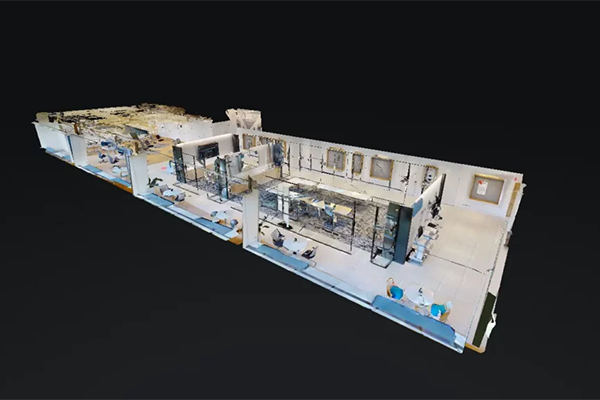
In today’s fast-evolving construction ecosystem, accuracy is not an advantage but a necessity. Every inch, every angle, and every element in the built environment adds to the success or failure of a project. It is here that Scan to BIM technology comes into play: it changes how as-built data in the AEC industry is captured, managed, and used.
At Genesis Infoserve, we have seen how Scan to BIM has turned conventional documentation into a data-rich, intelligent, and interactive digital model. Be it a retrofitting project, heritage restoration, or any upgrade of complicated facilities, this innovation has found its place in the workflows of modern construction.
The Shift from Conventional Surveying to Intelligent Reality Capture
Collection of as-built data was a cumbersome activity in the past, when surveyors applied measurement tools and paper-based documentation to make a note of every spatial detail. This process often resulted in time-consuming and error-ridden data. Nowadays, Scan to BIM removes these limitations using 3D laser scanning and photogrammetry that accurately capture real-world structure data.
It gets further converted into an intelligent Building Information Model, digitally and technically representing every element of the built environment. Much more than a 3D, it’s a fully enriched digital twin with geometry, spatial relationships, and metadata, forming an accurate basis for decisions.
Why Scan-to-BIM has become the backbone of modern projects:
The AEC industry is increasingly adopting Scan to BIM due to its ability to enhance project accuracy, reduce rework, and optimize resources. Here’s why this approach has become essential across construction and facility management projects:
Unmatched Accuracy:
3D laser scanning captures millions of data points per second, so nothing can ever be missed. Along with Scan to BIM, this gives rise to models representing the real world with millimeter accuracy.
Reduced Rework and Cost Savings:
Details in as-built models reduce on-site surprises and design conflicts. Teams can easily find clashes or deviations from the model at an early stage in the process.
Faster Renovation and Retrofitting:
It gives architects and engineers reliable data to design upgrades for existing buildings without having to revisit the site time and again.
Improved Coordination and Collaboration:
BIM platforms have made sharing 3D data between teams easy. Now, architects, structural engineers, and MEP consultants collaborate on one unified model.
Value Addition in Facilities Management:
The Scan to BIM model continues to add value even after the construction is over, acting like a digital reference for maintenance, renovation, and asset management.
How Scan to BIM Works: The Step-by-Step Process
The Scan to BIM workflow at Genesis Infoserve integrates state-of-the-art scanning devices with the latest BIM software, ensuring that the data is captured to a very high degree of fidelity. The process typically includes:
Laser Scanning & Data Collection:
High-resolution laser scanners capture millions of 3D data points, yielding a dense point cloud representation of the site.
Data Registration and Cleaning:
Multiple scans are aligned and cleaned to ensure noise removal, which allows for a cohesive data set.
Model Conversion:
The point cloud information is imported into BIM platforms like Autodesk Revit to produce intelligent 3D models.
Accuracy Validation:
Each element is checked and validated with the point cloud for model accuracy before final delivery.
Information Enrichment:
The model allows embedding metadata such as the type of materials, dimensions, and mechanical systems for future reference.
The whole process ensures that the client will get a visually accurate and information-rich as-built BIM model, ready to be integrated into digital construction workflows.
Trending Use Cases of Scan to BIM in 2025
The use of Scan to BIM has greatly expanded beyond basic documentation. Nowadays, it is applied in several trending and innovative applications, such as:
Smart City Development:
Urban planners make use of Scan to BIM while mapping existing cityscapes, which helps them carry out infrastructure upgrading and sustainable planning.
Historical Preservation:
Scan to BIM allows architects to digitally preserve and restore heritage sites with unparalleled accuracy.
Industrial and Plant Projects:
For detecting clashes in piping, MEP components, and structure, the Scan to BIM can be used in expansion that involve large facilities.
Facility Digital Twins:
Integrating the Scan to BIM with IoT and AI tools enables digital twin capabilities for real-time building monitoring and predicting maintenance needs.
Sustainability and Energy Audits: Accurate as-built models allow energy consultants to simulate building performance by finding opportunities for efficiency improvements.
How Genesis Infoserve adds value in Scan to BIM projects
Genesis Infoserve is a leading technology-driven company in the BIM domain, which offers end-to-end Scan to BIM solutions to meet the changing requirements of modern construction projects. Our team merges advanced laser scanning with profound skills in BIM modelling, BIM services, and digital project delivery.
Here is what sets our approach apart:
High-precision equipment:
Utilizing industry-leading scanners that capture point cloud data more precisely and faster.
Expert Modelers:
Our experts convert raw scan data into accurate BIM models in the architectural, structural, and MEP domains.
Flexible deliverables:
address the owner’s needs, from LOD 200 conceptual models to LOD 500 detailed as-built representations.
Seamless Integration:
Our Scan to BIM models can run in several BIM environments for easy collaboration among stakeholders.
Quality Assurance:
Each model undergoes extensive validation for geometric accuracy and consistency in data representation.
The Future of As-Built Documentation
Scan to BIM, the immediate future of Scan to BIM now has deep connections with automation, cloud collaboration, and AI-driven analytics.
The efficiency of automated scan-to-model conversion is rapidly improving, while cloud platforms are easing the process of sharing and updating as-built data in real time. One of the most talked-about concepts of late in construction technologies has to be digital twins, but Scan to BIM is the foundational layer that enables these. Moving ahead, the models will be able to show not just what exists but also performance, maintenance, and lifecycle behavior with sensors and real-time data integrated into them.
In times when precision is the driver of productivity, Scan to BIM is the game-changing solution for architects, engineers, and contractors. It bridges the gap between the physical and digital worlds, ensuring that every decision will be grounded in accurate, actionable information. At Genesis Infoserve, we are committed to delivering innovation that simplifies complexity. Through our Scan to BIM expertise, we help clients transform raw data into intelligent, value-driven digital assets, thereby empowering better design, construction, and facility management outcomes. And as technology continues to evolve and the demand for construction grows, one thing becomes clear: projects that adopt Scan to BIM today are building smarter, faster, and more sustainably for the future.