
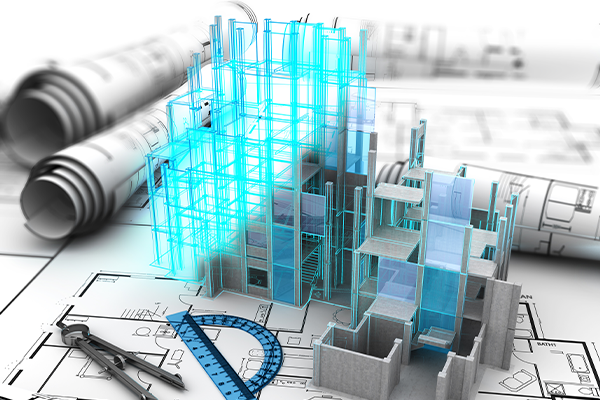
In the modern AEC landscape, which requires precision, collaboration, and data-driven decisions, defining project success is shifting. As the industry moves toward digital transformation, Building Information Modeling, or BIM, has emerged as the cornerstone of smarter project delivery. More than a technological advancement, it represents a rethink of how design, construction, and facility management are integrated into one intelligent workflow.
For the forward-looking company, investment in BIM Services is not an adoption of a tool; rather, it is a transformation into clarity, coordination, and control at every phase of the project lifecycle.
The Evolving Role of BIM in the USA on Modern Construction
Building Information Modeling has reshaped how architects, engineers, and contractors collaborate. BIM replaces traditional 2D drawings with a data-rich 3D model that serves as the central repository of information. From design intent to material specifications, including mechanical systems and cost estimates, every element is digitally represented and then easily accessible to all parties concerned.
This clarity, in today’s fast-moving construction sector, avoids misunderstandings, duplication of effort, and improves coordination amongst multidisciplinary teams. The result is a project that stays within its budget, meets timelines, and attains higher quality standards.
This is especially true as global demand for sustainable infrastructure and smart buildings has led to the development of BIM Services that now include more advanced solutions, such as 4D (time-based scheduling), 5D (cost estimation), and 6D (energy efficiency and lifecycle management). These can facilitate real-time decision-making, in line with the objectives of sustainability, safety, and performance.
Why BIM Services Matter in 2026 and Beyond
2026 is a new phase of the AEC industry, where technology and strategy come together in concert to create intelligent infrastructure. Governments and private developers are increasingly mandating BIM adoption to attain better efficiency and transparency in countries like the USA, UK, and Asia.
BIM Services have become very crucial because they put together design, engineering, and operations into one ecosystem. Here’s how they are revolutionizing the construction process:
1. Improved Collaboration and Coordination
BIM enables architects, engineers, contractors, and facility managers to work on a single model, which removes data silos and enhances accuracy. Such a collaborative platform can help find design clashes through early detection, with resolution virtually before they occur on site.
1. Better Design Accuracy
BIM enables architects, engineers, contractors, and facility managers to work on a single model, which removes data silos and enhances accuracy. Such a collaborative platform can help find design clashes through early detection, with resolution virtually before they occur on site.
2. Cost and Time Management Accuracy
With integrated data models, project managers are able to estimate the cost and timeline with unprecedented precision. BIM Services integrates cost estimation-5D BIM, scheduling-4D and, 4D BIM- to provide better control over budgets and project milestones.
3. Better Design Visualization
It is in the art of visualization that customer satisfaction lies. Building Information Modeling brings concepts alive through 3D simulations and virtual walkthroughs. Clients can explore design options, understand spatial relationships, and make informed decisions way before the onset of construction.
4. Risk Reduction & Quality Control
Predictive capabilities within BIM allow for the early identification of design clashes, material inefficiencies, and construction hazards. This proactive problem-solving approach avoids rework, enhances safety, and boosts the overall quality of the finished project.
5. Sustainability and Lifecycle Management
Sustainability has emerged as a major focus area in construction. BIM assesses the potential energy performance, material usage, and long-term maintenance of a building. This would further help green certifications with the necessary information on energy use, carbon footprint, and efficiency in operation.
The Strategic Edge of Professional BIM Consulting in the USA
While BIM technology is indeed powerful, its complete potential is realized through expertise and strategy. This is where BIM Consulting comes into play. A skilled BIM Consulting Company helps businesses plan, implement, and manage BIM processes for their specific project requirements.
BIM Consulting ensures that the digital workflow aligns with project goals, whether it be faster delivery, improved collaboration, or sustainable performance. This also enables smooth integration with other digital tools like GIS, IoT, and AI-based analytics, thereby allowing data to be transformed into actionable insights.
Professional consultants bring industry knowledge and technical proficiency in optimizing model accuracy, establishing standards, and ensuring interoperability across platforms. This strategic approach not only enhances design efficiency but also drives long-term value for construction firms and developers.
How in the USA BIM Services Are Transforming Project Delivery
The increasing adoption of BIM Services has significantly changed the ways in which projects are conceived and executed. From early design coordination to facility management, BIM forms a data-driven backbone on which decisions can be based.
Here’s a breakdown of the key transformation areas:
- Design Phase: Seamless coordination between architecture, structure, and MEP disciplines ensures design integrity.
- Construction Phase: Digital simulations predict site challenges and optimize construction sequencing.
- Post-construction phase: Facility management systems use BIM data for maintenance, renovation, and future expansion.
Furthermore, digital twins are also emerging as a major trend, these are real-time, data-rich replicas of physical assets. Digital twins, powered by BIM Services, will let facility owners monitor performance, efficiently manage assets, and predict maintenance needs.
The Global Shift: From 2D Plans to Intelligent Models
One of the most significant technological shifts to happen in the AEC industry within the past decade is its movement from traditional 2D drafting to 3D and 7D modeling. Building Information Modeling has accelerated this transition by turning data into intelligence.
With AI-driven clash detection, cloud collaboration, and AR/VR integrations, project stakeholders are now able to interact with models in immersive environments. This is the evolution that reshapes workflows and helps improve communication, making sure even the most complicated infrastructure projects are executed with precision.
The rise of smart cities and modular construction methodologies further strengthens the demand for BIM Services since such projects heavily rely on data coordination and real-time updates.
Genesis Infoserve: Empowering Construction with Intelligent BIM Solutions
At Genesis Infoserve, we value the uniqueness of every project. Therefore, we design our BIM Services to provide customized solutions that will enhance accuracy, productivity, and sustainability throughout the project phases.
From 3D modeling and coordination through to 6D facility management and digital twin integration, our team ensures that every stakeholder is in perfect alignment from design to execution.
As a trusted BIM consulting company, Genesis Infoserve uses leading expertise to help firms seamlessly implement BIM. We guide you on adopting appropriate technologies, creating data-driven workflows, and helping your projects meet global BIM standards.
Coupled with deep industry insight, Genesis Infoserve uses technology to empower architects, engineers, and contractors to achieve better results faster.
The Future of BIM in Construction
The future of BIM will be when the technology is integrated with AI, robotics, and real-time analytics. Predictive modeling, sustainability tracking, and cloud-based coordination will also be the new normal.
In this constantly changing world, the services of BIM are going to remain at the core of digital construction. They bridge the gap between imagination and execution, transforming how the built environment is designed, delivered, and maintained.
With the right BIM Consulting support, businesses can unlock limitless potential, enhancing profitability, reducing risk, and driving innovation at every stage.
BIM is no longer something of the future; rather, it is a present-day requirement that allows for achieving that much-needed precision, collaboration, and sustainability in modern projects, be it a residential tower, an industrial facility, or an infrastructure network. At Genesis Infoserve, we’re not merely adopting the future-we’re helping to build it. Through BIM Consulting and technology integration with data-driven project management, we facilitate each project from concept through completion with confidence and clarity.