
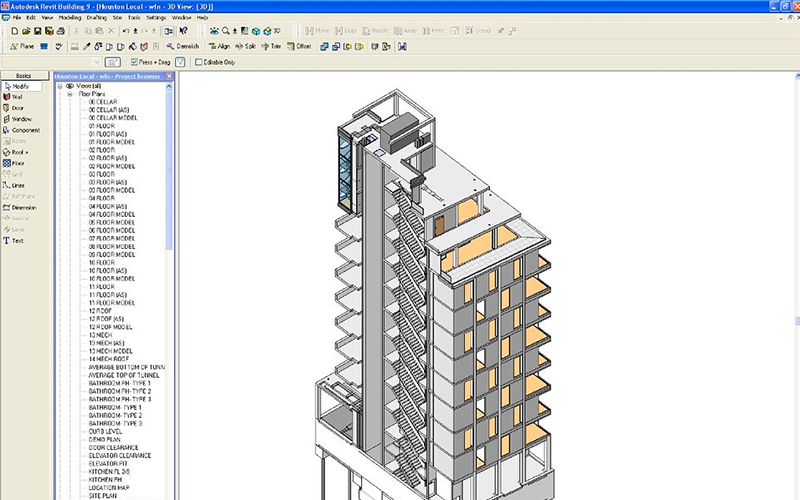
With the rapidly changing landscape of construction, architecture, and engineering comes a greater need for precision, speed, and teamwork. As construction projects advance in complexity and deadlines shorten, old-school 2D drafting techniques are no longer sufficient. This is where Revit Modeling comes into play as a game-changer. Genesis Infoserve has witnessed the revolution that Revit Modeling has brought to building design, coordination, and delivery, and made it an integral part of effective BIM workflow.
In this blog, we’ll explore what Revit Modeling is, its core features, and why it’s an essential tool for architects, engineers, contractors, and facility managers in today’s construction ecosystem.
What is Revit Modeling?
Revit Modeling is the act of modeling using Autodesk Revit software to produce smart, 3D digital models of buildings and infrastructure. Unlike basic drafting technology, Revit is a Building Information Modeling (BIM) platform that enables experts to design, simulate, visualize, and manage the physical and functional properties of a building over its lifecycle.
Every item in a Revit model, whether it’s a wall, window, pipe, or HVAC component, is more than just a shape, it’s a data-rich model infused with parameters like material, size, performance requirements, and cost. This has Revit Modeling significantly more than graphic representation, and it becomes a master source of truth for the project team.
At Genesis Infoserve, we leverage the potential of Revit to provide harmonized, precise, and effective modeling solutions in different disciplines to achieve top-class results for each project.
Why Revit Modeling Is Important
1. Enhanced Collaboration and Coordination
With today’s multi-disciplinary construction scenario, teamwork is essential. Revit provides various teams, architects, structural engineers, MEP consultants, and contractors, the ability to work on the same model in a common digital space. This collaborative platform breaks silos and facilitates improved communication.
Such changes are instantiated throughout the whole model as soon as one team makes them, so everyone then works with the most up-to-date information. Coordination at this level is particularly important in minimizing clashes and avoiding expensive mistakes in construction.
2. Clash Detection and Error Reduction
Conflicts in design, like HVAC ducts passing through beams or plumbing culting across electrical conduits, can lead to costly delays if they’re found on-site. Revit Modeling enables clash detection early on by merging architectural, structural, and MEP models.
By employing software like Navisworks in conjunction with Revit, Genesis Infoserve experts detect and resolve clashes upfront, avoiding rework and maintaining the project on time and budget.
3. Data-Rich Models for Smarter Decisions
One of the strongest strengths of Revit Modeling is the abundance of data that every elements contains. This data can be utilized for:
- Estimating the material
- Cost analysis
- Energy performance simulation
- Scheduling
- Lifecycle management
By putting all this data in one model, stakeholders can make better decisions at each step, right from conceptual design through to facility operation. We at Genesis Infoserve supply models that are not only visually correct but also analytically rich.
4. Time and Cost Savings
Conventional drafting demands that plans, sections, elevations, and schedules be documented separately. In Revit, they are all linked. Alter a dimension on the plan, and it will automatically update everywhere else, abolishing redundant work and curtailing human error.
This interconnectivity results in quicker turnaround, less document time, and less rework, cutting costs directly. Our clients enjoy shorter design cycles and reduced project overheads due to effective Revit Modeling.
5. Visualization and Presentation
Client approvals are quicker when stakeholders are able to visualize exactly what they’re receiving. Revit enables us to produce realistic 3D representations, walkthroughs, and renderings that assist clients in visualizing the finished product.
From schematic design to ultimate detailing, we employ Revit Modeling to create convincing visuals that convey the design intent. Not only does this improve communication but it also speeds up decision-making and approval of projects.
6. Lifecycle Management and FM Support
Revit is more than a design tool; it accommodates the entire building lifecycle. Facility managers can tap into valuable data for operations, maintenance, and future upgrades through models developed by Revit Modeling.
Genesis Infoserve offers as-built models and digital twins which can be trusted by facility managers for asset tracking, system performance monitoring, and long-term planning. This makes the model a living document that keeps on delivering value well beyond the end of the construction phase.
7. Flexibility Across Project Types
Whether it’s a residential complex, commercial tower, airport, hospital, school, or industrial facility, Revit Modeling is adaptable across multiple project types and scales. It supports architecture, structure, and MEP all under one roof, making it the most versatile modeling tool available today.
We at Genesis Infoserve have delivered Revit-based BIM solutions across a wide range of sectors, customizing our approach to meet the unique challenges and requirements of each project.
Major Features of Revit Modeling at Genesis Infoserve
- LOD-Based Models: We prepare models from LOD 100 (conceptual) to LOD 500 (as-built), depending on client requirements and project phase.
- Family Creation: We prepare bespoke Revit families based on specific equipment, fixtures, and design requirements.
- Parametric Design: Our parametric modeling ensures flexibility and immediate design modifications without loss of data.
- Multi-Platform Integration: Our Revit models are Navisworks, AutoCAD, BIM 360, and other industry platforms.
- Compliance-Driven Modeling: Our models meet international standards like AIA, COBie, and ISO 19650 for quality and compliance.
Our Revit Modeling Workflow
1. Requirement Analysis:
We start with project scope, discipline focus (Architecture, Structure, MEP), and deliverables understanding.
2. Input Collection:
Our experts collect input drawings, markups, point clouds, sketches, or input models to create a starting point for modeling.
3. Model Development:
With Revit, we develop a rich, detailed model incorporating all the parameters, tags, and component requirements.
4. Quality Checks & Coordination:
Every model is put through strict QA/QC, clash detection, and validation for compliance.
5. Delivery & Support:
We return the last model in the stipulated formats and offer continued support for revisions, updates, and integration.
Revit Modeling is more than a design step, it’s the key to smart construction. It enables teams to construct more intelligently, lower risk, and maximize efficiency at each step of the project. At Genesis Infoserve, we are committed to leading this digital revolution by providing end-to-end Revit Modeling solutions that bring success to our customers.
Whether you’re embarking on a new project, remodeling an existing building, or operating a complex facility, our Revit services mean you’re with precise, coordinated, and future-proof models.