
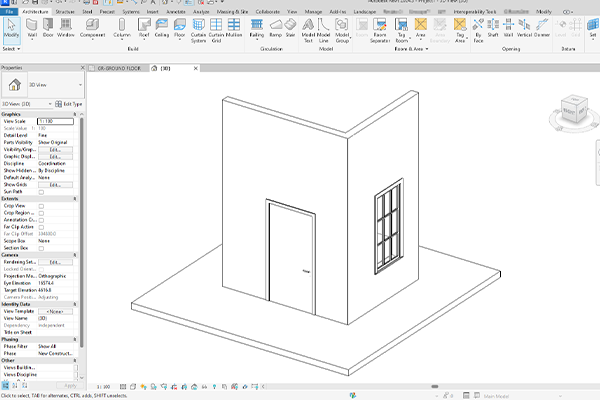
In the modern era of digital transformation, construction and design are changing more rapidly than ever before. Efficiency, collaboration, and accuracy are no longer options; they are essential. Various technologies were involved in changing the face of the AEC industry, one of which is Revit Modelling. Created by Autodesk, Revit makes it possible to visualize, plan, and provide an edge to projects with great accuracy via Building Information Modelling.
At Genesis Infoserve, we power the leading edge of Revit Modelling in providing smart, coordinated, and data-driven design solutions to our clients. Our expertise means that every project benefits from seamless collaboration and accurate detailing, right from concepts to construction. Let’s dig deeper into what makes Revit software such a crucial tool for modern construction workflows.
What is Revit Software?
Revit by Autodesk is a BIM-based software application that enables architects, engineers, and contractors to create intelligent 3D models. Unlike traditional CAD systems, which only produce 2D drawings, Revit provides a fully integrated environment in which every element of the design-walls, doors, beams, HVAC systems, or electrical layouts-is connected within a single model.
That means any changes in one view (let’s say, a floor plan) automatically update in all other views, like elevation, sections, schedules, and so on, maintaining full consistency and reducing the likelihood of errors. Such features of parametric modelling differentiate Revit Modelling from other conventional design tools.
Why Revit Is Essential for Modern Construction Projects
The construction industry today demands accuracy, coordination, and cost efficiency. Revit helps achieve all three by providing a unified platform that bridges the gap between design and execution.
Here’s why Revit Modelling has become indispensable:
Seamless Collaboration:
Revit allows multiple disciplines like architecture, structure, and MEP to work together on the same model. That way, it ensures that everyone’s on the same page and reduces conflicts or rework.
Data-Driven Design:
Every item in Revit contains information, from dimensions to materials and quantities. This allows for better decision-making during each phase of the project.
Precision and Consistency:
Any change in the model is automatically reflected in the documentation, ensuring consistency of drawings, schedules, and sections at all times.
Reduced Project Costs:
Real-time collaboration and clash detection in Revit can vastly reduce design errors and subsequent construction delays, therefore economizing resources.
At Genesis Infoserve, we tap into these capabilities of Revit Modelling to help our clients streamline workflows, enhance coordination, and ultimately deliver a better quality project outcome.
Key Features of Revit Software
Revit is a powerful platform that supports every stage of the building life cycle, from conceptual design through facility management. Below are some of its most impactful features that make Revit Modelling part and parcel of modern BIM practices.
1. Parametric Components
The basis of Revit lies in its parametric components, or as they call them, “families.” These are intelligent objects that know how they relate to other elements within the model. For example, when changing the height of a wall, the associated doors, windows, and structural elements will adjust automatically.
This feature saves not only time but also maintains design integrity across the model, which is one of the core strengths of Revit Modelling.
2. Centralized Model and Worksharing
Revit supports a collaborative workflow wherein multiple users share access to and make changes to the central model. Each team member works on their local copy, and the changes are synchronized back into the shared model.
This capability ensures smooth collaboration between different project stakeholders and avoids version conflicts, which is invaluable for a large construction project.
3. Schedules and Quantities
Schedules in Revit are automatically generated from model data. Whether it’s door schedules, material takeoffs, or area calculations, the software keeps all documentation updated in real time.
For project managers and estimators, this feature provides accurate insights into cost, material usage, and timelines-all extracted directly from the Revit Modelling environment.
4. Visualization and Rendering
With Revit, designers can create high-quality visualizations or realistic renderings right within the software. These visuals help stakeholders better understand the design intent and make more informed decisions earlier on in the project lifecycle.
The incorporation of visualization tools enhances the presentation quality, allowing Genesis Infoserve to effectively communicate the design ideas across to clients and partners.
5. Clash Detection and Coordination
One of the strongest benefits of Revit Modelling is clash detection within architectural, structural, and MEP elements before the beginning of construction. The early detection of such conflicts minimizes costly on-site errors and ensures smoother project execution.
6. Documentation Automation
Automated documentation tools within Revit help in creating detailed construction documents with very minimal human intervention. Any changes made in the model are reflected in the plans, elevation, sections, and detail sheets instantaneously; hence, all outputs remain updated and accurate.
For companies like Genesis Infoserve, this feature has improved productivity, reduced turnaround times, and ensured a high level of documentation quality.
7. Energy Analysis and Sustainability
Increased concerns over sustainability are being heard in the AEC industry, for which Revit provides integrated analysis tools. Designers can evaluate energy performance, lighting, and environmental impact directly within the Revit Modelling workspace.
This enables us to design structures that are efficient yet sensitive to the environment.
How Genesis Infoserve Utilizes Revit Modelling
At Genesis Infoserve, we believe technology should enhance creativity, not limit it. Our team of BIM experts uses Revit Modelling to bring clarity and precision to complex construction projects. From conceptual planning to final documentation, our process ensures complete alignment with client requirements and industry standards.
Here’s how we apply the strengths of Revit to real-world scenarios:
We create detailed architectural layouts, including walls, doors, and finishes, according to both aesthetic and functional goals.
Structural and MEP Coordination:
We integrate the structure and MEP systems in one Revit Modelling environment, which reduces coordination errors and optimizes design efficiency.
Construction Documentation:
We provide our clients with accurate, fully annotated documentation sets derived directly from the model, which ensures speed, consistency, and reliability.
BIM Integration:
Revit is an important player within our broader integrated BIM ecosystem for data management, coordination, and tracking through the asset lifecycle with multiple stakeholders.
We combine our domain expertise with the advanced capabilities of Revit to help clients realize smarter, more efficient, and future-ready infrastructure.
Design the Future with Revit.
As the construction landscape continues to undergo digital transformation, Revit Modelling is surely going to remain at the heart of innovation. The future will entail deeper integrations of cloud collaboration, AI-assisted modelling, and advanced simulations aimed at improving accuracy, sustainability, and project delivery speed. Genesis Infoserve keeps pace with the developments, upgrading our workflow systems continuously to deliver value-driven solutions. Our commitment to technology and precision ensures that clients receive results that are both innovative and dependable.
Revit is more than a software; it is a complete ecosystem for smarter design and efficient project execution. With powerful features, data intelligence, and collaboration tools, Revit Modelling continues to reshape how the construction business is done. At Genesis Infoserve, we harness the full potential of Revit to deliver excellence in every project. Whether it be architectural detailing, structural modelling, or integrating with BIM, our expertise in Revit ensures quality, coordination, and innovation in each phase. If you seek to upgrade your project in terms of precision, efficiency, and visualization with an advanced BIM workflow, Genesis Infoserve is a trusted partner in Revit Modelling and BIM excellence.