
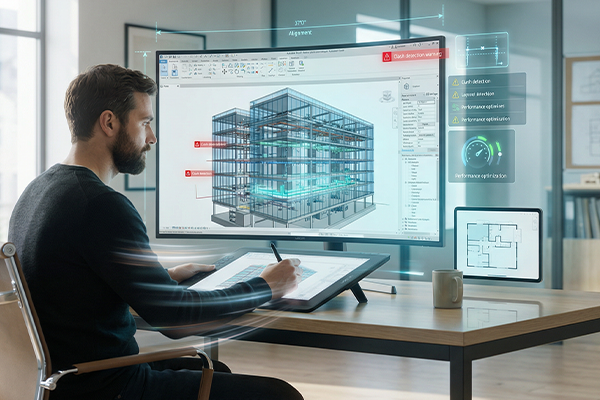
In today’s time, engineering projects require a certain level of precision, coordination, and predictability that was not seen earlier. With tight timelines, complex systems, and an increasing number of stakeholder expectations, there is little room for mistakes or rework. That’s where Revit Modelling becomes essential: to transform engineering teams from disconnected workflows to smarter, model-based project delivery.
At Genesis Infoserve, we engage with engineering firms to strengthen their modeling practice. Our aim is to make Revit something more than a drafting tool: a robust platform for design coordination, constructability, and lifecycle planning.
Why Revit Modelling Matters to Engineering Teams
Engineering disciplines are highly interrelated; structural, mechanical, electrical, and plumbing disciplines are deeply intertwined. A small change in one domain can make ripples through the others. Revit Modelling creates a common space in which the interdependencies are clear and managed.
Done correctly, Revit Modelling helps engineering teams:
- Maintain design accuracy during revisions
- Increase interdisciplinary coordination
- Minimize clashes before construction
- Create high-quality, consistent documentation
However, to achieve such results requires more than simple software knowledge.
Establish Clear Modeling Standards at the Outset
Probably the most effective way of improving Revit Modelling is by establishing clear standards early in the project. If rules have not been defined, models become inconsistent and quickly difficult to manage and error-prone.
Engineering teams should have:
- Naming conventions for families and views
- Level of Detail requirements at every project stage
- File structuring and workset strategies
- Annotation and documentation guidelines
Standardized workflows ensure that, throughout the project, Revit Modelling remains organized and scalable.
Focus on Intelligent, Not Overloaded Models
A common myth is that more detail makes a better model. In practice, overly complex models slow performance and make coordination cumbersome. The goal of Revit Modelling should be intelligence, not unnecessary geometry.
Engineering models should contain:
- Accurate system layouts
- Correct parametric data
- Relevant performance information
Limit additions to information that serves to facilitate the design decisions, coordination, and construction.
Enhancing Interdisciplinary Coordination
Engineering projects seldom succeed independently. Structural grids, mechanical systems, electrical routing, and plumbing networks all must align both spatially and functionally. Revit Modelling allows for this coordination when models are shared and reviewed regularly.
Improved coordination practices include:
- Frequent model exchanges between disciplines
- Regular coordination reviews
- Early identification of spatial conflicts
Engineering teams can solve site issues digitally with the help of Revit Modelling as a collaborative platform.
Utilize Families Strategically
Families in Revit are the basic building blocks of solid modeling. If the families are not properly constructed, then the integrity of the model can be affected. In order to increase the model integrity in Revit modelling, engineers and technicians should focus on properly structured families.
Important points to bear in mind:
- Parametric flexibility
- Correct geometry and connectors
- Consistent data parameters
When families are properly managed, modeling becomes easier, and the documentation will stay up to date.
Integrate Clash Detection within the Workflow
The benefit of Clash Detection is much bigger than simple badge-wearing when it comes to project coordination tools, it’s only as effective as the quality of your model. If your Revit model is in good shape, the clashes identified become actionable insights.
Clash detection should be considered as an ongoing process rather than a one-off task. In doing so, you avoid design modifications that could disrupt the smooth execution of the construction process.
Enhance Documentation with Model-Driven Outputs
One of the strengths of Revit Modelling is that it allows for direct extraction of drawings from a model. When the model is accurate, documentation is both accurate and easy to manage.
Methods to Improve the Quality of Documentation:
- Ensure that every modeled element is categorized correctly
- Model geometry and annotations should stay synchronized
- Review views and sheets periodically
Modelling-driven documentation erases discrepancies and helps develop more confidence among all parties participating in the project.
Invest in Team Training and Skill Development
The most intelligent workflows break down when the users are not comfortable with them. Training is an ongoing process to realize the full benefit of Revit Modelling in engineering projects. Teams are encouraged to stay current with evolving software functionality, best practices, and industry standards.
At Genesis Infoserve, we advocate for structured modeling approaches that enable engineering teams to use Revit with much more functionality and consistency in their projects.
Quality Control and Model Audits
Regular model audits are essential to maintaining the accuracy of the project throughout the project cycle. Such reviews underline issues related to modeling practices, consistency of data, and readiness for coordination.
Quality-focused Revit Modelling includes the following:
- Periodic checks are made for modeling errors
- System connectivity testing or validation
- Data Completeness Review
This discipline keeps the model valid from concept through construction.
Genesis Infoserve’s Approach towards Revit Modelling
At Genesis Infoserve, Revit Modelling is not a mere activity, it’s an engineering application that helps in the smart execution of projects. Our company organizes operations, collaborates with other teams from the beginning, and follows strict quality checks.
Things we assist engineering teams with doing:
- Increased accuracy and consistency of model performance
- Increased inter-discipline co-ordination
- Reduced rework and design conflicts
- Construction-ready models that are ready to be built
It also makes sure that our approach leads to the application of Revit for true engineering.
Conclusion
Enhancement of Revit Modelling for engineering projects is not about introducing too many complexities. It is all about clarity, coordination, and control. By understanding clear standards, disciplined work practices, and a collaborative approach, it is possible to unlock the complete power of Revit Modelling as a central project hub. With every project expanding in size and complexity, the right Revit Modelling practices remain paramount for their successful execution. Genesis Infoserve is committed to assisting engineering professionals in accomplishing this excellence, one coordinated model at a time.