
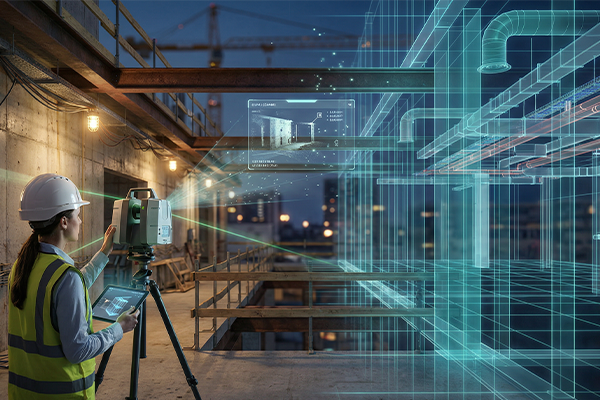
Assumptions are a thing of the past in today’s world of building and renovation, because when it comes to accuracy, “nice to have” doesn’t cut it anymore. With many existing structures, you have designs that aren’t complete, information that’s outdated, or changes that were implemented but never noted in official documents. Rather than taking chances, Scan to BIM technology becomes a game-changer by allowing members of a team to scan what’s on site to a very high level of accuracy and develop models from that information, which can be trusted.
At Genesis Infoserve, we embrace this technology-inspired mindset to help architects, engineers, contractors, and facility owners deal with data they can trust -data that accurately reflects the actual, physical condition of the facility.
Why Existing Condition Data Accuracy is More Important Than Ever
Today, there is a growing need for renovations and retrofit projects for commercial, industrial, and infrastructure projects. A significant number of such projects have older buildings for which the original plans are no longer available, or they no longer accurately depict the existing building conditions. Conventional site surveys may fail to accurately depict complicated shapes, cramped spaces, and concealed utilities. Scan to BIM addresses this problem by creating a digital record of existing building conditions that is then converted to an intelligent BIM model. This leads to a significant reduction in any doubts from the outset of the project.
What is Scan to BIM?
Scan to BIM is a process that begins with creating a real-world scan of the site using a laser scanner. The scanners measure millions of data points, called point clouds, which determine the real geometry of the building and each of its components. Once acquired, the point cloud data can then be processed and used to create a BIM model of what was actually measured, recreated with millimeter accuracy when required. The resultant model is essentially a twin of the real building.
Step 1-Laser Scanning of Real Environment
The first stage employs the use of high-definition laser scanning. The operators set the scanners in different points around the projects to scan walls, floors, ceilings, and visible MEP. The process ensures:
- Extensive coverage of the structure
- Correct representation of irregular shapes
- Little disruption to ongoing operations
Scanning is non-intrusive and thus is suited for occupied facilities such as hospitals, office buildings, and industrial facilities.
Step 2. Development and Validation of Point Clouds
The scan data is then combined into a single, integrated point cloud, which provides a vivid 3D representation of the project area. The point cloud is then considered the foundation of the entire Scan to BIM process. During this phase, checks are performed on the data quality of accuracy, alignment, and completeness, and any gaps or misalignments are corrected before any modeling takes place.
Step 3: Conversion of Turning Point Clouds to BIM Models
After successful validation, the point cloud data is then imported to the BIM software, where experienced modelers create the architectural, structural, and MEP systems. This is the most crucial step in the Scan to BIM process, whereby the raw data is utilized to create a model with operational qualities. Depending on the project requirements, the model is then created at different levels of development.
Architectural Accuracy Representation
For architects, Scan to BIM offers a real-life, accurate representation of floor plans, elevations, section views, and relationships between spaces. Angled floors, irregular walls, and odd, irregular dimensions that might be overlooked during a manual survey are replicated accurately. This level of detail allows architects to make exterior remodeling and interior additions to a structure with great certainty, since what they are working with represents actual conditions.
Supporting Structural Understanding
The components of the structure, including columns, beams, slabs, and load-bearing walls, are also created from the scan results. This has been a massive leap forward for renovation projects, as the ability to understand the structure has been of paramount importance in these endeavors. With the use of Scan to BIM, structural engineers minimize guesswork and non-destructive tests and improve the design process.
Increasing MEP Visibility and Coordination
Problems arise in many existing buildings where undocumented MEP systems create a significant challenge. “Scan to BIM” allows you to document what you see: ducting, pipes, cable trays, and equipment, making it possible to plan and coordinate better. With the information integrated with BIM processes, clash resolution, rerouting concepts, and constructability validation reduce the chances of surprises when actual construction commences.
Why Scan to BIM Is Essential to Renovation and Retrofit Projects
Renovations usually have to work under time-constrained budgets where one mistake can have domino effects of cost escalation. Scan to BIM offers a reliable and proven foundation for making architectural renovation decisions by referencing designs to existing conditions.
Key Benefits:
- Less rework and fewer change orders
- Increased speed of design validations
- Improved cross-discipline coordination
- Increased confidence during construction
These are reasons why Scan to BIM is the best option for complex renovation projects.
Supporting Facility Management and Lifecycle Planning
Outside the realm of designing and building, Scan to BIM also provides immense value to facility owners. These BIM models enable space management, maintenance, and asset tracking, besides renovations that would be done in the future.
Genesis Infoserve’s Methodology for Scan to BIM
At Genesis Infoserve, Scan to BIM represents a service that transcends technical execution to genuinely offer strategic value through minimizing risks and maximizing outcomes. At Genesis, our Scan to BIM professionals integrate data precision with modeling rigor to provide clients with accurate, reliable, and optimized models that truly serve a purpose in a given project.
We at Genesis Infoserve can tailor our Scan to BIM services to suit a client’s requirements, whether its emphasis lies in design development, coordination, documentation, or perhaps asset maintenance.
Uniting Real-World Data with Reliable Decisions
However, the true potential for Scan to BIM is found in integrating the physical and digital domains. When the physical domain is accurately represented with building information that is converted to intelligent models, the result is a sense of understanding, certainty, and control for the project team.
As buildings change and renovation complexities increase, Scan to BIM is an essential tool for future success. As a team at Genesis Infoserve, our goal is to ensure our clients maximize Scan to BIM’s benefits through the conversion of existing buildings into sound digital foundations for the future.