
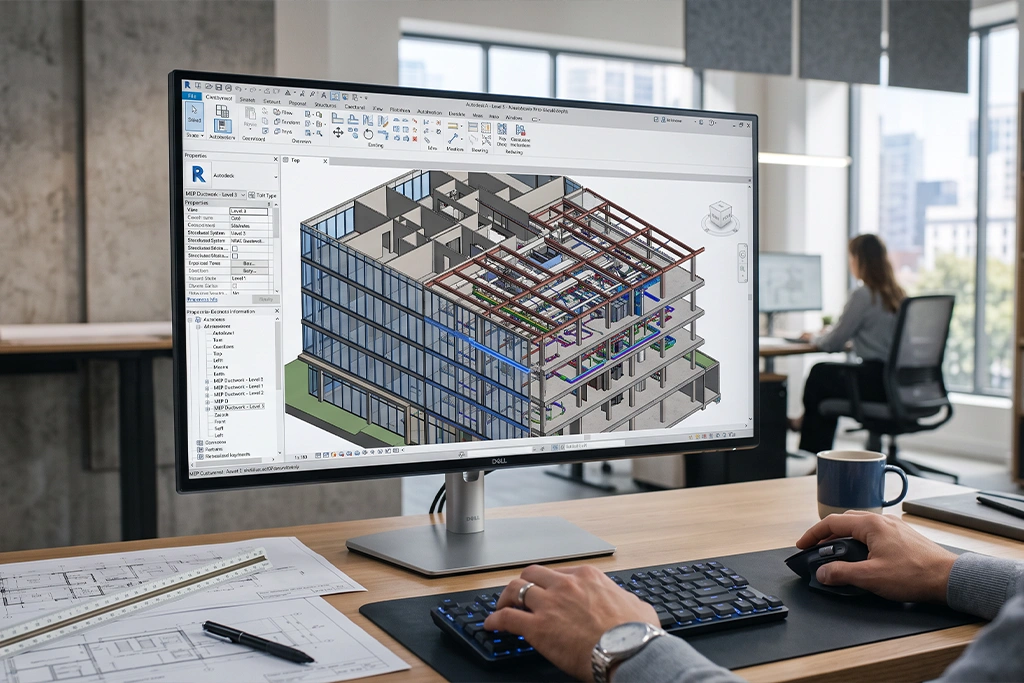
Revit is no longer used only to create detailed 3D building models and drawings. Modern AEC projects demand better collaboration, cleaner data, faster coordination, and workflows that can support teams throughout design and construction. As a result, REVIT modelling is evolving from a model-production task into a more connected project process.
For companies seeking reliable BIM services, this shift is important. Genesis Infoserve understands the changing requirements of digital project delivery, where BIM modelling increasingly connects with cloud collaboration, automation, coordination, and information management. The focus is no longer on creating the most detailed model possible but on creating a model that is accurate, useful, efficient, and accessible to the right project stakeholders.
From 3D Modelling To Connected BIM Workflows
Earlier Revit workflows often focused on producing a digital building model and extracting drawings from it. Today, that model may also support design coordination, quantity information, construction planning, clash review, documentation, and asset information.
This has made Revit a more connected part of the wider building information modelling process. Autodesk supports cloud-based workflows that allow teams to collaborate on Revit models and centralise project data, although the exact cloud workflow depends on the model type and required services.
The model is therefore becoming less of an isolated file and more of a shared source of project information.
1. Cloud Collaboration Is Changing How Teams Work
Distributed project teams are becoming increasingly common. Architects, engineers, consultants, and contractors may work from different offices or locations, making traditional file-sharing methods difficult to manage.
Cloud worksharing allows multiple authorised team members to work on shared Revit models through connected project environments. Autodesk describes Revit Cloud Worksharing as a workflow that allows teams to co-author models, centralise design data, and collaborate across locations.
This is changing everyday REVIT modelling practices. Teams now need to pay closer attention to:
- Access permissions
- Model publishing
- Version control
- Syncing and collaboration discipline
- Shared project standards
Cloud collaboration does not automatically solve workflow problems. Clear processes are still necessary to prevent confusion and maintain model quality.
2. Automation Is Reducing Repetitive Work
Many Revit tasks are repetitive. Setting up views, managing parameters, checking information, and handling certain documentation processes can consume considerable time when completed manually.
Automation tools such as Dynamo are helping BIM teams reduce this burden. Instead of repeating the same action across hundreds of elements, teams can create structured workflows for selected tasks.
Automation can support:
- Parameter updates
- Data extraction
- Repetitive modelling tasks
- View and sheet setup
- Model checking
- Documentation workflows
The purpose is not to replace professional judgement. Rather, automation allows BIM professionals to spend more time on coordination, problem-solving, and quality control.
This is also changing the skills expected from professionals working in the services of BIM. A basic understanding of automation and workflow improvement can be highly valuable, even when a professional is not an advanced programmer.
3. Lean Models Are Becoming More Valuable Than Over-Detailed Models
A highly detailed model is not necessarily a high-quality model.
One of the most important changes in modern BIM is the focus on creating models that are appropriate for their purpose. Excessive geometry, unnecessary detail, poorly managed families, and inefficient content can affect model performance and slow down project teams.
A practical model should provide the information required for its intended use without adding unnecessary complexity.
Teams are increasingly reviewing:
- Unused content
- Excessive geometry
- Warning messages
- Workset organisation
- Linked models
- File performance
This creates an important shift in thinking. Instead of asking, “Can this element be modelled in more detail?” teams are increasingly asking, “Does this additional detail provide project value?”
4. Coordination Is Becoming A Continuous Process
Traditional coordination often took place at major project milestones. Teams would complete a stage of work, exchange models, and then review potential conflicts.
Modern workflows increasingly support more frequent coordination.
This is especially important in BIM construction, where design changes can affect installation, sequencing, procurement, and site activities. Early coordination allows teams to identify issues before they become expensive or difficult to correct.
Revit models can also form part of wider coordination workflows involving linked models and specialist coordination platforms. Autodesk’s collaboration ecosystem supports model aggregation, clash detection, issue management, and multidisciplinary coordination.
The result is a move from occasional coordination reviews toward a more continuous approach.
5. Interoperability Is Becoming A Core Requirement
Modern AEC projects rarely depend on one software platform.
Architectural teams may use different design tools, structural teams may work with specialist platforms, and construction teams may use separate coordination systems. This makes interoperability increasingly important for architectural modelling and wider BIM delivery.
The ability to share useful information between platforms is often more valuable than simply transferring an entire model. Teams need to understand how geometry, data, and project information can move between different systems without creating unnecessary duplication or information loss.
This is why modern Revit professionals need to understand both modelling and the wider digital environment in which the model operates.
6. Information Quality Is Becoming As Important As Geometry
The development of building information modelling has made it clear that a BIM model is more than a visual 3D representation.
Elements may contain information related to:
- Materials
- Specifications
- Quantities
- Classification
- Performance
- Installation requirements
This information can support design decisions, coordination, construction planning, and future asset management.
As a result, modern architectural modelling is becoming more data-aware. A model with reliable, well-structured information can often provide greater value than a visually complex model containing inconsistent or unnecessary data.
7. Model Performance Is Becoming A Workflow Responsibility
As projects become larger, model performance becomes increasingly important. Slow models can affect productivity across the entire project team.
Common factors that can affect performance include:
- Excessive model detail
- Poorly managed links
- Large or inefficient families
- Unnecessary warnings
- Poor work-sharing practices
Cloud collaboration can improve access and coordination, but teams still need to maintain good modelling discipline. Autodesk’s guidance distinguishes between cloud models and cloud worksharing, highlighting that different workflows have different collaboration capabilities and requirements.
This means performance management must begin at the modelling stage rather than being treated as a problem to solve later.
Key Changes In Modern Revit Workflows
Evolution | Impact on Project Delivery |
Cloud collaboration | Supports distributed project teams |
Automation | Reduces repetitive manual work |
Lean modelling | Improves model performance |
Continuous coordination | Helps identify issues earlier |
Interoperability | Supports multidisciplinary workflows |
Structured information | Improves data reliability |
Performance management | Supports smoother project delivery |
The Role Of BIM Professionals Is Also Changing
The modern BIM professional needs to understand more than software commands.
Strong professionals are increasingly expected to understand:
- Model quality
- Coordination workflows
- Information management
- Construction requirements
- Automation opportunities
- Cloud collaboration
- Interoperability
This does not make traditional modelling skills less important. Accurate and well-structured modelling remains the foundation of every successful BIM construction.
However, the role is expanding. A modeller’s decisions can influence coordination, documentation, construction planning, and information exchange across the project.
What The Future Of Revit Modelling May Look Like
The future of this modelling is likely to become more connected, automated, and information-focused.
Revit remains a desktop application, but Autodesk continues to provide cloud services that extend its collaboration, data management, and model-sharing capabilities.
This suggests that future workflows will not necessarily be about replacing Revit. Instead, the focus will be on connecting it more effectively with:
- Cloud collaboration platforms
- Automation tools
- Coordination systems
- Other design software
- Construction workflows
- Structured project information
For businesses investing in BIM services, the priority should be to build workflows that are accurate, scalable, and practical for real project requirements.
Summary
The evolution of REVIT modelling reflects the wider transformation taking place across the AEC industry. Revit is no longer limited to producing drawings or creating detailed 3D geometry. It is increasingly part of connected workflows that support collaboration, coordination, automation, construction, and information management.
The most effective BIM modelling strategies focus on creating models that are useful rather than unnecessarily complex. Better coordination, cleaner data, efficient workflows, and stronger interoperability are becoming just as important as modelling accuracy.
Genesis Infoserve helps organisations adapt to the changing requirements of modern BIM and digital AEC delivery. As project workflows continue to evolve, businesses that combine strong modelling practices with better information management and collaboration will be better positioned to deliver efficient and coordinated projects.
FAQs:
1. How is REVIT modelling evolving for modern BIM projects?
It is becoming more connected to cloud collaboration, automation, multidisciplinary coordination, structured information management, and construction workflows.
2. Why is model performance important in BIM projects?
Poor model performance can slow down project teams and affect productivity. Efficient modelling practices help maintain smoother project workflows.
3. How does automation support Revit workflows?
Automation can reduce repetitive tasks such as data updates, view setup, checking, and selected documentation processes.
4. What role does Revit play in BIM construction?
Revit can support design development, documentation, coordination, information management, and collaboration with wider construction workflows.
5. Is architectural modelling still important as BIM workflows become more automated?
Yes. Automation can reduce repetitive work, but accurate modelling, design understanding, coordination skills, and reliable information remain essential.